
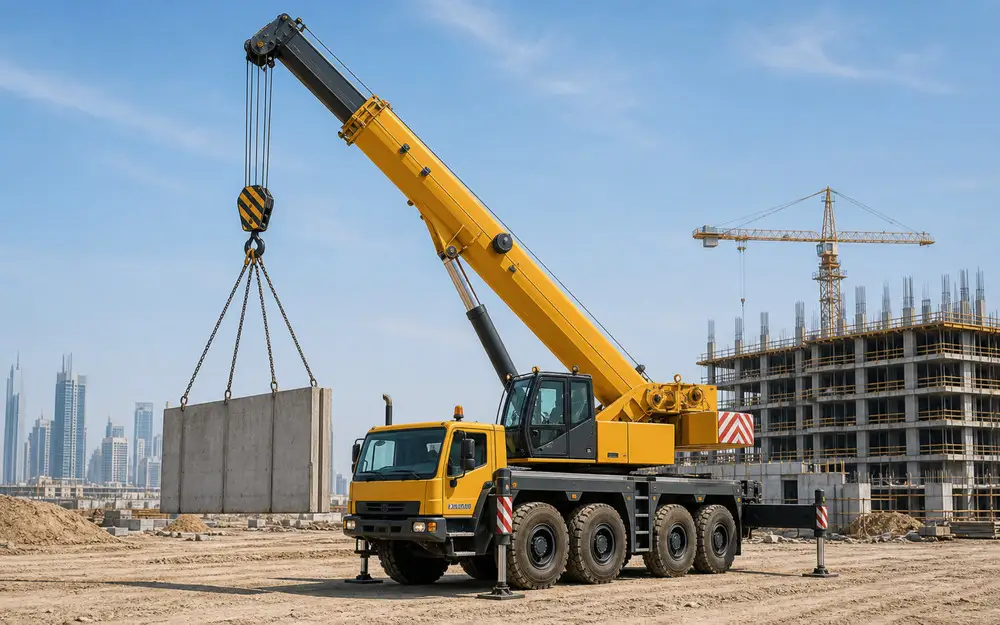
A mobile crane is chosen for the heaviest load at the furthest distance it must be lifted, not for the load alone. A 25-ton crane may lift a heavy item close to its body but only a fraction of that at full reach. Understanding load, radius, height and ground conditions helps you ask for the right crane class and prepare a safe lift. Our mobile cranes range from 25 to 250 ton classes.
The total load is more than the item
The weight the crane lifts includes the item, the slings, shackles, spreader beams and the hook block. Get the item’s weight from its documents, the manufacturer or a delivery note, not from a guess. If the item’s centre of gravity is off-centre, say so, because it affects how it is rigged.
Radius decides capacity
The radius is the horizontal distance from the crane’s centre of rotation to the load’s hook. Every crane has a load chart that gives the maximum load for each combination of radius and boom length, and capacity falls quickly as radius increases. The key figures are the radius at the pickup point and at the set-down point, whichever is larger. This is why the crane’s position on site matters as much as the item’s weight.
Height and obstacles
The boom must be long enough to clear the building, wall or structure between the crane and the set-down point, with room for the rigging above the load. Note the height of any obstacle and the height at which the load must land.
Setting up the crane
A mobile crane spreads its weight through outriggers onto the ground. The ground under each outrigger must carry that load, which may need outrigger mats or a prepared surface. Buried services, basements, soft fill and recent excavations near the setup position are serious hazards. The site must also have room for the crane to extend its outriggers fully.
People and control
A lift needs a competent person to plan and supervise it, a rigger or slinger to attach the load and a signaller who can see the load when the operator cannot. Set up an exclusion zone under the load path. Wind affects large, flat loads such as panels and sheets, so agree a wind limit for the lift.
Further reading
The UK Health and Safety Executive’s guidance on planning and organising lifting operations sets out the principles in more detail.