
Tracked excavators dominate Dubai sites, but a specific family of jobs is better served by wheels: urban and roadside work where the machine must move along paved surfaces, reposition frequently, and avoid chewing up asphalt that nobody budgeted to repair. This guide explains where a wheel excavator earns its hire and what to check before booking one.
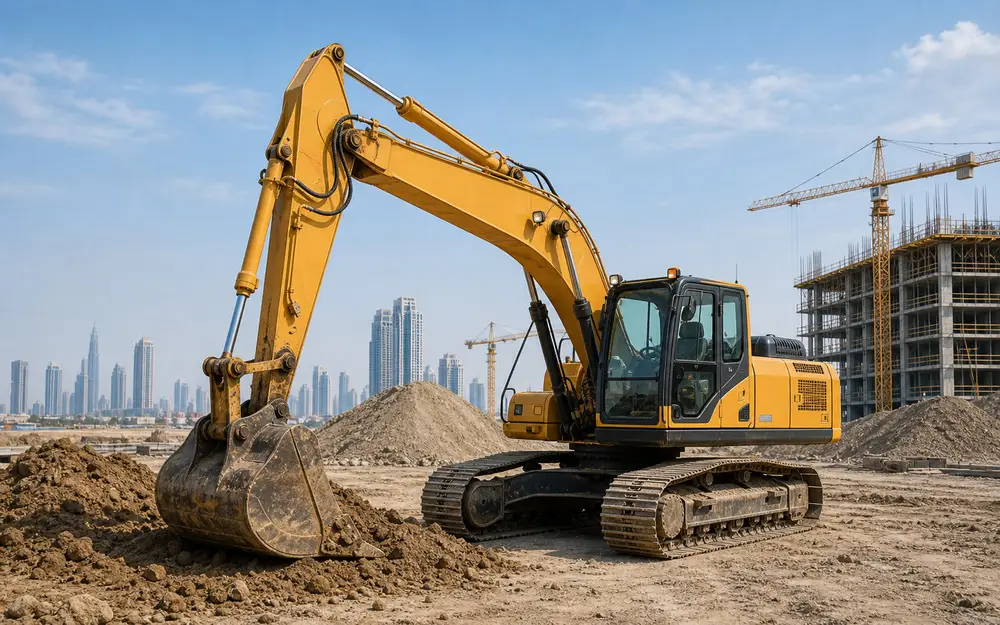
Wheeled vs tracked excavator
| Factor | Wheel excavator | Tracked excavator |
|---|---|---|
| Paved surfaces | Drives without damage | Damages asphalt; needs mats or transport |
| Repositioning | Fast, self-driven between points | Slow; long moves need a low bed |
| Soft ground | Limited | Superior flotation and stability |
| Heavy digging | Good with stabilisers deployed | Best-in-class |
Urban and roadside use cases
- Roadside utility repairs and connection points along live carriageways
- Municipal-style maintenance with multiple stops per shift
- Urban trenching where the route follows paved streets
- Short-hop tasks across a paved industrial campus
Paved-surface benefits
The economic case is transport and surface damage: a wheel excavator drives between nearby work points instead of waiting for a low bed, and leaves the asphalt it worked on intact. On multi-stop days, the time saved repositioning often outweighs any digging-speed difference.
Access and traffic planning
Roadside work lives or dies on planning: where the machine stands, how traffic passes, whether a lane closure is needed and at what hours the work is permitted. Describe the road situation in the enquiry — curbside, service road, inside a campus — and note that stabilisers need their own footprint when digging hard.
Quote checklist
- Job description and dig depth
- Roadside or campus context + photos of the work points
- Number of work locations per day
- Any lane-closure or timing constraints
- Location pin and duration
Ask if a wheel excavator suits your job: WhatsApp the details to +971 54 738 8695 — if tracks are the better answer, you will be told so.
FAQs
Is a wheel excavator as strong as a tracked one?
With stabilisers down it digs seriously; the difference shows on soft ground and the heaviest work, where tracks win. The main excavator page covers the tracked classes.
Can it travel between sites on public roads?
Local movement is part of the machine’s design; longer transfers are still planned properly. Share the points on a map and the travel plan comes with the quote.
What site details matter for roadside excavation?
Share lane width, traffic controls, underground-service information, digging depth, spoil location and the surface the machine will stand on. Road or authority requirements must be arranged before work begins.
Related rental pages
- Excavator rental Dubai
- Trenching excavator rental Dubai
- Excavator rental Dubai South
- Request a quote
Why UK plant hire says “rubber duck”
In UK construction and plant-hire usage, “rubber duck” is a regional nickname for a wheeled 360-degree excavator. Established UK plant-hire catalogues pair the nickname with their wheeled excavator fleets, and UK public-procurement lots have used the same wording in machine descriptions. The term describes the wheeled machine category in that market; it is not a universal engineering classification, a manufacturer model name or another term for zero tail swing.
For a Dubai booking, use the technical name “wheeled excavator” and send the operating weight, road or site movement needs, stabiliser footprint, digging depth and attachment requirement. If a UK drawing or plant schedule says “rubber duck,” confirm that it means a wheeled excavator rather than assuming the nickname defines size or tail geometry.
Sources reviewed
Source review updated 16 August 2026. The terminology note is regional; current manufacturer specifications remain authoritative for machine selection.