
Construction yards and site compounds need a lot of small, repeated handling work: moving aggregate from stockpiles, cleaning around batching and storage areas, loading waste and keeping access roads clear. A compact loader such as the CAT 226B is useful for this work where a larger wheel loader would be too big or underused. This guide covers how to plan it for yards and sites in Ras Al Khaimah.
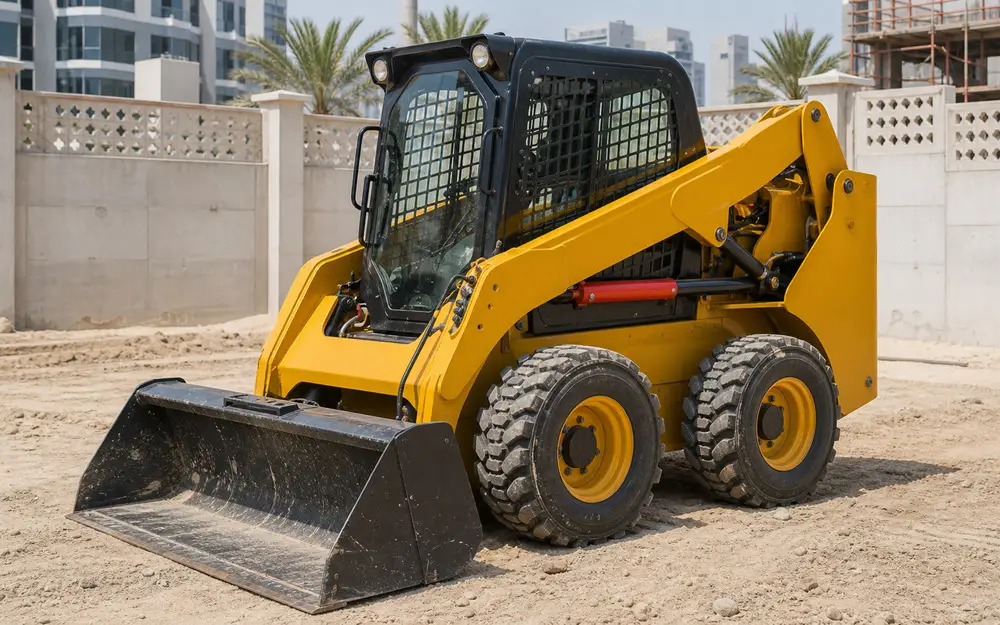
Is a compact loader the right size?
The CAT 226B has a rated operating capacity of 680 kg, so it moves material in many small bucket loads. That is efficient for housekeeping, short moves and loading skips, but slow for large volumes over long distances. If the yard handles large stockpiles or loads many trucks a day, compare a wheel loader before booking.
Map the yard’s routes
Mark where the loader will travel between stockpiles, loading points and waste areas. Yards are shared with trucks, forklifts and people on foot, so agree one-way routes or times when the loader works alone, and who acts as a lookout when trucks are reversing.
Describe the materials
Sand, gravel, crushed concrete, soil and mixed waste all load differently. Heavy or wet material fills the bucket’s weight limit before its volume, so the loader carries less per trip. Say what the main materials are and roughly how much needs to be moved.
Mind the ground
Yard surfaces break up around stockpiles and turning areas. Soft or rutted ground slows a wheeled loader and increases wear. Show photos of the worst areas, and fill or level them before the job if you can.
Regular work or one-off clean-up?
For regular yard housekeeping, ask about booking the machine for fixed days each week or for a longer period. For a one-off clean-up before a handover or inspection, list every area to be cleared, so the job can be priced and scheduled as one visit.
What to send
Map pin, yard photos, the main materials and rough quantities, whether trucks will be loaded, the working hours of the yard, and whether you need regular or one-off work.