
A reach truck is designed to store more pallets in the same building: it works in narrower aisles than a counterbalance forklift and lifts pallets to high racking. Whether you need one depends on your aisle widths, rack heights and floor. UAE Equipment Rental does not rent reach trucks; we supply counterbalance forklifts from 3 to 25 tons. This guide is general information to help you decide which type your warehouse needs.
How the two machines differ
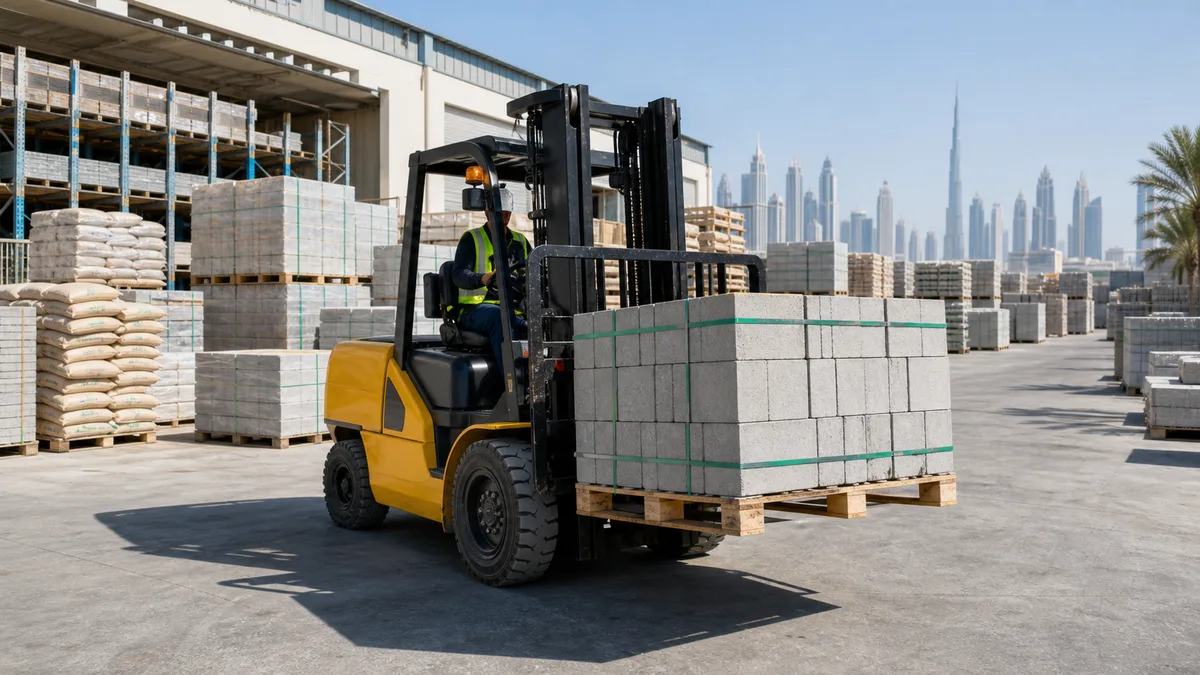
A counterbalance forklift carries the load in front of its wheels, balanced by a heavy counterweight at the back, so it needs wide aisles to turn. It works indoors and outdoors, on yards and at truck beds. A reach truck moves its mast or forks forward to reach into the rack and then retracts them, so it turns in much narrower aisles. It is an indoor machine, usually battery-powered, and needs smooth, level floors.
When a reach truck makes sense
- Aisles are narrow, often under 3 metres, to fit more racking.
- Racking is high, where lifting capacity at height matters.
- The work is mostly indoors, on good concrete floors.
If you also load and unload trucks in the yard, a counterbalance forklift is usually still needed for that part of the job.
Details that decide the choice
Measure the aisle width between rack faces, the height of the top beam, the heaviest pallet’s weight and size, and the floor condition. Check the capacity at the actual lift height, because capacity falls as the forks go higher.
Questions to ask a reach truck supplier
- What is the residual capacity at my top beam height?
- What aisle width does the machine need with my pallet size?
- What charging arrangements and floor standard does it need?
Where we can help
For yard work, loading trucks, container stuffing and moving heavy loads, our counterbalance forklifts cover 3, 5, 7, 10, 15 and 25 ton classes, including container-mast models.