
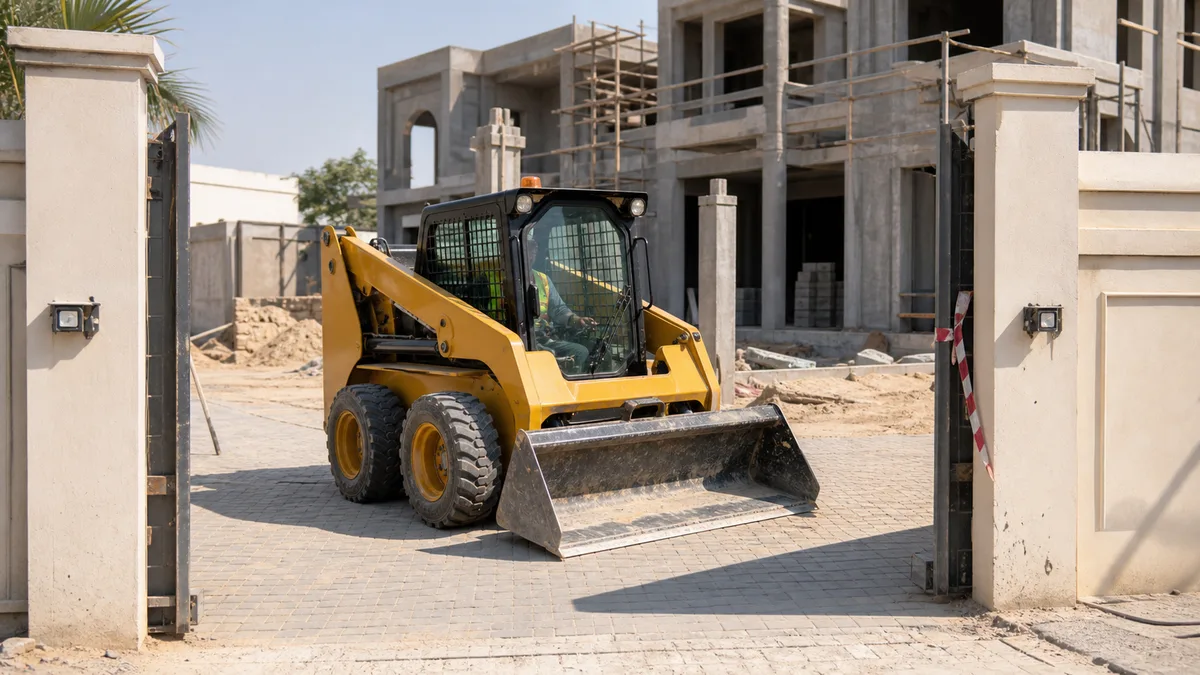
Many Ajman jobs are small residential plots, villa extensions and short-frontage commercial units on busy streets. A compact loader suits this work because it is small enough to work inside a plot, but only if the street, the gate and the space around the plot allow the transport truck and the machine to work safely.
Look at the street first
Narrow residential streets, parked cars and nearby shops can leave no place for a transport truck to stop and unload. Check where the truck can stand for a few minutes, whether neighbours’ cars need to be moved, and whether the unloading would block anyone’s entrance. Tell your neighbours when the machine is coming.
Measure the gate and the space inside
Measure the gate opening with both leaves fully open, and check for steps, kerbs, overhanging balconies or cables. Inside the plot, the machine needs room to turn and to reach the pile from the side. If the work area is behind the house, measure the side passage as well.
Protect what is already finished
Small plots often have finished walls, tiles, paving or garden areas close to the work. Mark what must not be touched, and ask for boards or protection where the machine must cross a finished surface. It is easier to agree this before the operator starts than to repair it after.
Plan where the material goes
On a small plot there is rarely space to stockpile. If rubble or sand leaves the site, book the tipper or skip so that it arrives when the Bobcat is ready to load, and make sure it can stand close enough to the gate. If material stays on site, show where it will be spread or placed.
Keep the booking short and efficient
Small jobs are often finished in a few hours when the site is ready. Clear the route, confirm the tipper and have someone on site to open the gate. Ask whether a half-day booking suits the job.
What to send
Map pin, a photo of the street outside the gate, gate width, photos of the work area and any side passage, the material and rough quantity, where it goes, and your preferred time.