
Most warehouse equipment enquiries start with the wrong question: “how much is a forklift?” The better question is “which machine does my layout actually need?” — because the answer might be a forklift, a reach truck, a pallet stacker, an order picker, or a combination, and each prices differently. This hub page matches Dubai warehouse scenarios to machines, so your enquiry starts with the right machine class and ends with a faster, more accurate quote.
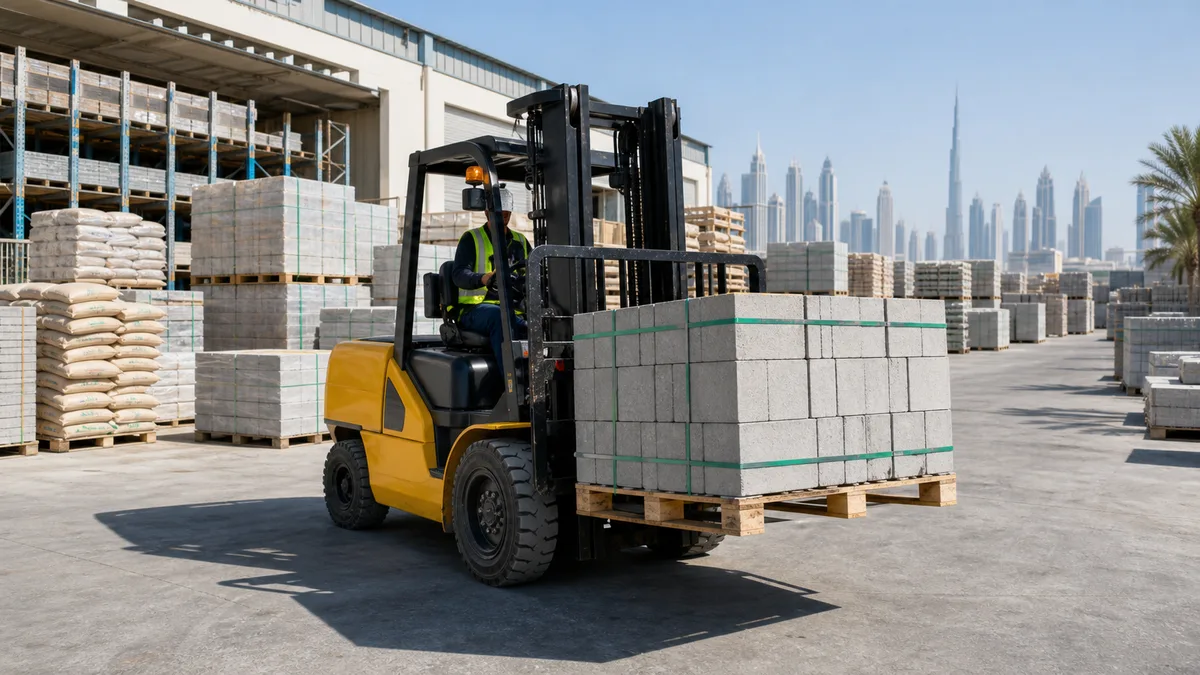
Common warehouse rental scenarios
- Relocations: emptying, moving and restocking a facility — usually forklifts plus transport; the relocation planning guide sequences it.
- Overflow and peak seasons: extra machines for fulfilment spikes and inventory builds.
- Racking work: installations and reconfigurations needing precise lifting.
- Fit-out and commissioning: first-fill of a new facility before permanent fleet arrives.
- Breakdown cover: a rental unit holding the line while owned machines are repaired.
Choosing between forklifts, reach trucks and stackers
| Machine | Best at | Needs |
|---|---|---|
| Counterbalance forklift | Docks, trucks, general movement | Wide aisles; indoor/outdoor per type |
| Electric forklift | Enclosed, fume-free facilities | Flat slab, charging point |
| Reach truck | High-bay racking, narrow aisles | Finished floors, indoor only |
| Pallet stacker | Light loads, tight back-of-house | Smooth floors, moderate heights |
| Order picker | Person-to-stock picking at height | Racking layout designed for it |
What layout details matter
Five numbers describe almost any warehouse job: heaviest pallet weight, top beam height, clear aisle width, dock or ground-level loading, and shift hours. With those five, machine matching is immediate; without them, every quote is a guess. Walk the aisle with a tape measure before enquiring — it is ten minutes that saves days.
Short-term vs long-term warehouse support
Daily hire suits events: a delivery day, a stock count, a single move. Anything recurring belongs on weekly or monthly structure, where rates improve and the machine stays put. Mixed fleets — a reach truck in the racks, a counterbalance on the dock — are normal and often cheaper than forcing one machine to do both jobs badly.
Quote checklist
- The five layout numbers above
- Scenario: relocation, peak, racking, fit-out, cover
- Facility pin and access notes
- Dates, duration and shifts
Tell us about your warehouse layout: WhatsApp the five numbers to +971 54 738 8695 and get machine matching plus pricing in one reply.
FAQs
Can I rent several machine types together?
Yes — combined packages for relocations and peaks are standard and priced as one job.
Do machines come with operators?
Operated hire is standard; bare rental for licensed in-house teams can be discussed per machine class.
Should warehouse equipment be electric or diesel?
Electric machines generally suit enclosed finished-floor areas when charging is available; diesel equipment is more commonly considered for ventilated outdoor yards. Confirm floor, ventilation, shift and charging conditions.
Related rental pages
- Forklift rental Dubai: 3 to 25 ton
- Reach truck rental Dubai
- Cargo transport services Dubai
- Request a quote
Manual, semi-automated and driverless handling
Warehouse automation is a system choice, not simply a forklift without a driver. Manual equipment leaves travel and load decisions with the operator. Semi-automated equipment may automate a repeatable movement while still requiring a person to start, supervise or take over the task. ISO 3691-4:2023 uses the broader category “driverless industrial trucks” and includes automated guided vehicles, autonomous mobile robots, automated guided carts and related systems, including machines that also have manual or maintenance modes.
For a practical warehouse comparison, record how the vehicle navigates, what happens when its route is blocked, how jobs reach it from the warehouse-management system, how charging is scheduled, and how people are separated from or allowed to interact with the operating zone. MHI’s material-handling automation material describes multiple AGV types and navigation approaches, while ISO emphasizes that the operating-zone condition materially affects safe operation. A short or highly variable rental job may still suit manual equipment better; a repeatable high-volume flow deserves an automation study using measured task volumes and exception rates.
Sources reviewed
- ISO 3691-4:2023, safety requirements for driverless industrial trucks and their systems.
- MHI Mobile Automation Group, AGV types, navigation and system context.
Source review updated 16 August 2026. This overview does not replace a facility-specific automation design or safety assessment.