
Moving sand looks simple, but the speed of the job depends on details that are easy to overlook: how far each load travels, whether the sand is dry or wet, and whether the truck or placement point is ready when the loader arrives. This guide covers sand shifting and sand removal with a Bobcat on UAE sites, when a larger wheel loader is the better choice, and what to send for an accurate quote.
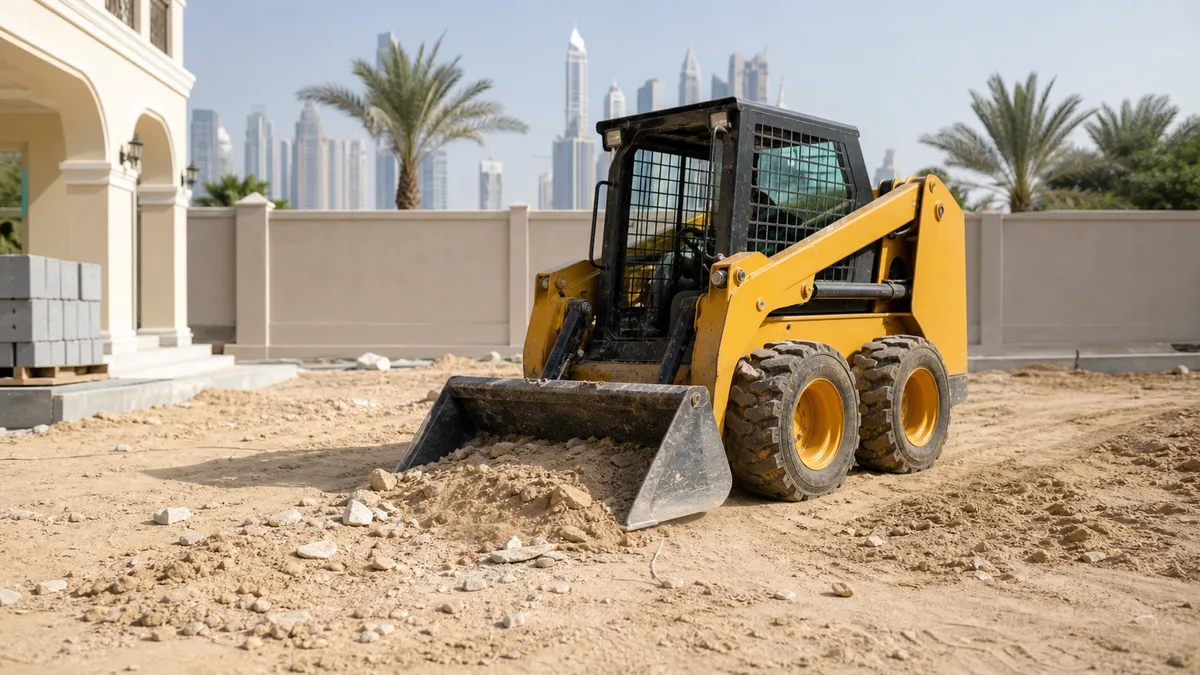
Shifting on site or removing it from site?
Sand shifting usually means moving a pile from one part of the plot to another: from the delivery point to the work area, or away from a wall before construction starts. Sand removal means loading it into trucks so it leaves the site. The Bobcat does both, but removal also depends on trucks arriving at the right rate, so say which one you need when you ask for a quote.
Keep the carry distance short
A compact loader moves sand in many small loads, so every extra metre between the pile and the tipping point is repeated dozens of times. Put the tipper, skip or new stockpile as close to the source as access allows, and keep the route between them clear of parked cars and stored materials.
Dry or damp sand changes the load
The CAT 226B we supply with an operator is rated at 680 kg per load. Dry sand flows easily but spills during travel. Damp sand holds together better but is heavier, so the bucket reaches the weight limit before it looks full. Freshly watered or saturated sand is the heaviest of all. Tell the team the condition of the sand so the time can be estimated realistically.
Watch the ground under the wheels
Deep, loose sand is hard going for a wheeled loader and can dig ruts along the route. A firmer path, for example along a compacted strip, keeps each trip quick. Send photos of the route, not just the pile.
Loading trucks for sand removal
The tipper needs firm, level ground next to the loading point, and the loader must be able to reach over its side. Book trucks at a steady rate: too few and the loader waits, too many and trucks queue in the street. If you also need the sand carried away by road, our cargo team handles raw-material transport; the raw materials transport guide explains what to prepare.
When a wheel loader is faster
For large volumes moved across open ground, or many trucks to load in a day, a wheel loader moves far more per bucket. See wheel loader rental for the 950 and 966 classes. Many sites use both: the wheel loader on the main pile and the Bobcat in tight corners.
Placing, filling and levelling
If sand is being placed for a later trade, such as bedding for paving or fill behind a wall, agree the exact area and rough level. The loader can spread and roughly level; precise levels are set afterwards by the trade that needs them. The levelling guide and the trench backfilling guide cover those jobs in more detail.
Dust and neighbours
Dry sand blows in the wind. On residential sites, damp the pile lightly, avoid windy periods where possible, and keep the street clean where trucks leave.
Send these details for a sand job quote
- rough quantity or pile size, and whether the sand is dry or damp;
- whether the sand stays on site or must be removed;
- the distance from the pile to the placement point or truck;
- whether trucks are already booked;
- photos of the pile, the route and the gate, and your preferred date.
Send them to Equipment Rental Enquiries on +971 54 738 8695 by phone or WhatsApp, or use the equipment enquiry form. For booking and prices, see Bobcat rental in Dubai.
Frequently Asked Questions
How much sand can a Bobcat move in one load?
The CAT 226B is rated at 680 kg per load. Damp or wet sand reaches that limit before the bucket looks full, so heavy sand moves in more, smaller trips.
Can the sand be removed from site as well?
Yes. The Bobcat loads the trucks, and road transport of raw materials can be arranged through Cargo & Transport Enquiries on +971 55 388 5075. Say how much sand must leave the site when you ask for the quote.
Bobcat or wheel loader for sand?
A Bobcat suits tight plots, short carries and moderate quantities. For large piles on open ground, or many trucks in a day, a wheel loader is usually faster.