
A skid steer is only as useful as the tool on its front. The same machine can load sand in the morning, move pallets at midday and drill fence-post holes in the afternoon, provided the right attachments are on site. Attachments for our CAT 226B include a bucket, forks, an auger, a broom, a trencher and a hammer, depending on availability. This guide explains what each one is for and what to tell the team so the right tool arrives.
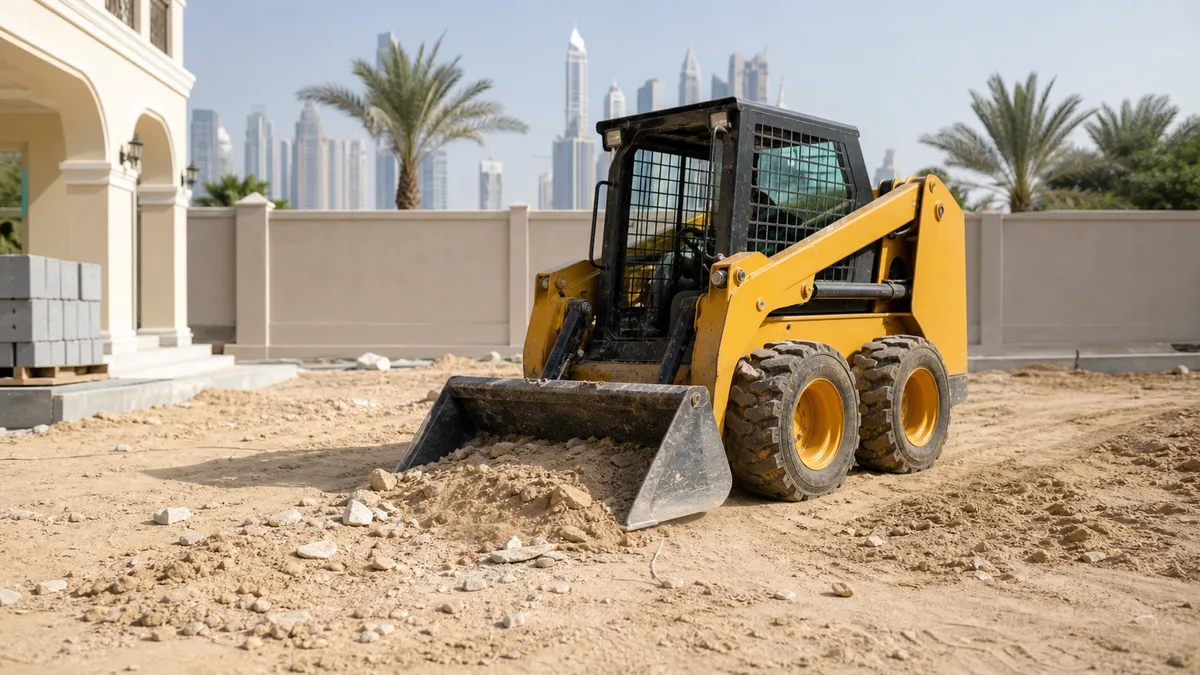
Bucket: loading, carrying and spreading
The bucket is the standard tool for moving sand, soil, gravel and rubble, loading skips and tippers, spreading fill and rough levelling. Tell the team the material and whether it is loose, compacted or mixed with debris. Heavy, wet material reaches the machine’s weight limit before the bucket is full.
Forks: pallets and packed materials
Pallet forks turn the loader into a small yard handler for blocks, bagged materials and palletised goods over short distances on firm ground. Give the pallet weight and size. For heavy loads, high stacking or long distances, a forklift is usually the better machine.
Auger: holes for posts and planting
An auger drills round holes for fence posts, sign posts and tree planting. The key details are the hole diameter, the depth, the number of holes and the ground: sand, compacted fill or rock-hard ground behave very differently. Mark underground services before drilling.
Broom: sweeping paved areas
A broom clears dust, sand and fine debris from roads, yards and paved areas, which a bucket tends to leave behind. Say what surface is being swept and whether dust suppression is needed nearby.
Trencher: narrow, shallow trenches
A trencher cuts narrow trenches for cables or irrigation where a bucket would dig too wide. Give the trench width, depth and length. Deeper or wider trenches need an excavator.
Hammer: light breaking
A skid steer hammer breaks thin concrete slabs, kerbs and light hardstanding in places a larger excavator cannot reach. For thick or heavily reinforced concrete, an excavator with a breaker is more effective.
Ask for the combination you need
If the job needs two tools, for example a hammer to break a path and a bucket to load the pieces, ask for both in the same booking. Confirm availability of every attachment for your date, because each attachment is a separate item.